
Inheritance Tax
Inheritance Tax is a complex subject like all things financial planning. We help you plan early so your assets are passed on in the way you want them to be while ensuring that your Inheritance Tax bill is reduced or managed in the most effective way.
What is inheritance Tax?
Inheritance Tax is a tax on the estate of someone who has died. It is a tax on property, money or possessions. There is normally no Inheritance Tax to pay if the value of your estate is below the £325,000 threshold or if you decide to leave everything above the £350,000 threshold to your spouse, civil partner, to a charity or to a community sports club for example. Either way, if the estate’s value is below this threshold you still need to let HMRC know.
However, if you do find yourself in a position where the value of your estate is above the £325,000 threshold you will be charged on the part of your estate which is above the threshold. The standard Inheritance Tax rate is 40 per cent.
Our team of Inheritance Tax specialists will help you plan early so you can continue to enjoy living your life while ensuring you have enough money to do the things you want to do.
“Inheritance Tax is charged at 40 per cent on estates in excess of £325,000. There are many and varied methods of mitigating such a tax.”
Peter McGahan writes in the Irish News
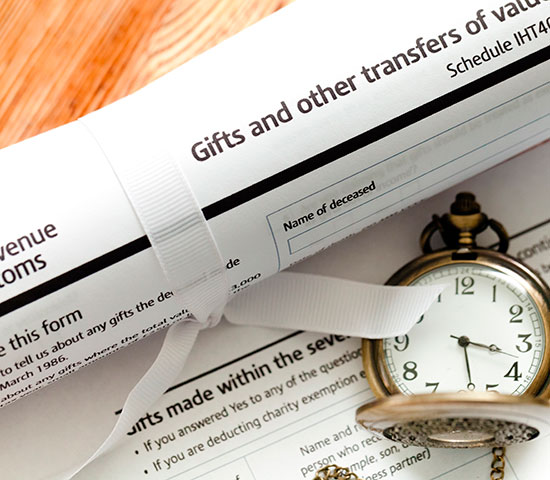
How To Mitigate Against Paying Inheritance Tax
Planning ahead has many benefits – one of which of course is making sure you are not being charged tax unnecessarily. One of the most straightforward ways of doing this is to give some of your assets away while you are alive.
You are allowed to make some gifts and there are lots of ways in which you can do so your appointed adviser will take you through those different options and explain them in detail to you.
Who can I give money to tax free?
When you speak to one of our Inheritance Tax specialists you will be guided as to who you can give money to tax free. Gifts to your spouse or your civil partner are usually tax free but this doesn’t include unmarried partners.
You can make gifts to your family and other individuals. If you are thinking about leaving money to your children then it’s important to plan how you do this. When you gift someone, while you are alive, more than seven years before your death, this is tax free. Tax, however, might be payable depending on whether or not you live seven years since you make the gift.
You could also gift money to your children through a mortgage deposit but again this is something we will talk you through.

Inheritance Tax and Trusts
The rules around Inheritance Tax and Trusts are complicated so your appointed Worldwide Financial Planning adviser will guide you through this before you decide to set up a trust as a way of avoiding Inheritance Tax. Trusts can often be overlooked as a means to managing your estate when you pass away. They allow you to have an element of control over what happens to your estate and how your assets can be used.
Things to ask your adviser should include;
- How do trusts work?
- How are trusts taxed?
- How do the tax charges work?
- What sort of trusts can be set up?
- What will a trust cost?

Inheritance Tax on Property
When you pass away, Inheritance Tax is levied on your property as is the case with the vast majority of assets. In April 2017, an extra allowance was introduced which means couples can now leave property worth up to £1million before having to pay any tax. This tax free amount will depend on who you decide to leave your property to when you pass away and also the overall value of your estate.
Inheritance Tax For Married Couples & Civil Partners
There’s no doubt there are benefits to being married or being in a civil partnership when it comes to Inheritance Tax. If the first partner dies, and leaves their entire estate to their partner, there is no tax to pay. If the first person in the marriage, or civil partnership, dies, and if there are any thresholds which have not been fully used, the unused part can go to the surviving partner. What this means is that the basic tax free threshold can be as much as £650,000 for the surviving partner if none of the £325,000 was used.
Contact Worldwide Financial Planning
Frequently asked questions
This is a tax on any part of your estate which exceeds your personal allowance which is also known as the nil rate band – ie – your personal allowance which is free from Inheritance Tax. This is currently £325,000 and is a combination of property, savings, investments, other assets and also gifts which you give away in the seven years which lead up to your death.
It’ll be one of two rates – it is usually 40 per cent but if you decide to give at least 10 per cent of your estate to charity when you die, the Inheritance Tax rate is reduced to 36 per cent.
Your independent financial adviser will guide you through your estate planning so you can pass on your assets to your children for example in the most tax efficient way possible. Working with your adviser, first stage of estate planning is to conduct some fact-finding in order to understand all the assets owned, whether that be cash, property, investment or trust funds. You’ll have established now why Inheritance Tax is a big element of any estate planning as your adviser will work to minimise this as and where possible.
The residence nil band rate is an allowance for the passing on of a family home. The rate is £175,000 and can be transferred between spouses or civil partners. This rate only applies to your own home and not a buy-to-let property. For people with much larger estates, the rate is reduced by £1 for every £2 that the estate is valued at over £2million.
- Small gifts
are deemed to be less than £250 in value. If you gift your son, or niece, or nephew a number of gifts amounting to £250 or less, that’s fine to do so but you can’t do this for someone who has already benefited from your annual exemption. You can give away a total of £3,000 worth of gifts each tax year without them being added to the value of your estate. This is known as your ‘annual exemption’.
Gifts from income may also be tax free. Think about it this way – you can give someone money from your salary or your pension and it won’t be counted as Inheritance Tax. HMRC say these gifts need to form a regular spending pattern. If you have an ex-husband, ex-wife, ex-civil partner or relative who is dependent on your for maintenance, these gifts would be considered tax free. Also exempt from Inheritance Tax are gifts for the maintenance, education or training for children under the age of 18.
- Wedding gifts are also exempt from Inheritance Tax if the gift is made prior to the wedding taking place and only if the wedding does go ahead. Check with your independent financial adviser as to how much you can gift a couple getting married.
- Donations to charities and political parties are also exempt from Inheritance Tax. To give you an example, you would not have to pay Inheritance Tax of gifts to national museums, amateur sports clubs, UK charities, The National Trust, political parties. Again, speak with your adviser on this matter because if you do decide to make a gift in your will, to a charity or political party, you may qualify for a reduced Inheritance Tax rate.
Potentially Exempt Transfers, or PET, as they are known, are gifts which you make to other people during your lifetime unless they fall into the list of tax-free gifts. Generally speaking they are applied to your £325,000 tax-free allowance before the rest of your estate. If you make the gift, and are still alive seven years after making that gift, no Inheritance Tax is due. However, if you die within seven years of the gift being made then the gift is considered part of your estate for inheritance tax purposes.
You’ll have seen us mentioning the seven year rule – basically that’s Taper Relief. If you made a potentially exempt gift which was bigger than the nil rate band, you could benefit from this relief which gradually reduces the amount of chargeable Inheritance Tax over the seven years after you made the gift.
In each tax year that you are alive you can give up to £3,000 in total.
Ask your adviser for more detail on this as some people do hold back because they are worried about running out of money later in life. Your adviser will show you how much money you need to maintain your chosen lifestyle and they will also take into account your expenses such as the cost of long term care.
Yes. Pensions are not included when your Inheritance Tax bill is calculated. If you are in a financially healthy position, and do not need to access your pension, then yes, you can pass your pension on tax free while you reduce the size of your taxable estate.
A trust can help you keep control of what happens to your assets when you die. Your adviser will help you with this of course. The rules around Inheritance Tax and trusts are complicated and could end up costing you more if it’s not handled properly.
Sign up for our newsletter
You may also be interested in...

Mortgages
Getting a mortgage is quite possibly one of the biggest financial decisions you may ever have to make so it is so important to get it right.

Protection
Protecting your money is one of the most important things you can do in terms of protecting yourself, your family and your business.

Business Finance
Thinking about starting a business, or running a business, can be hard enough. Get good advice on how to access business finance to help you grow.